
Last updated
How many restrooms does a farm crew need?
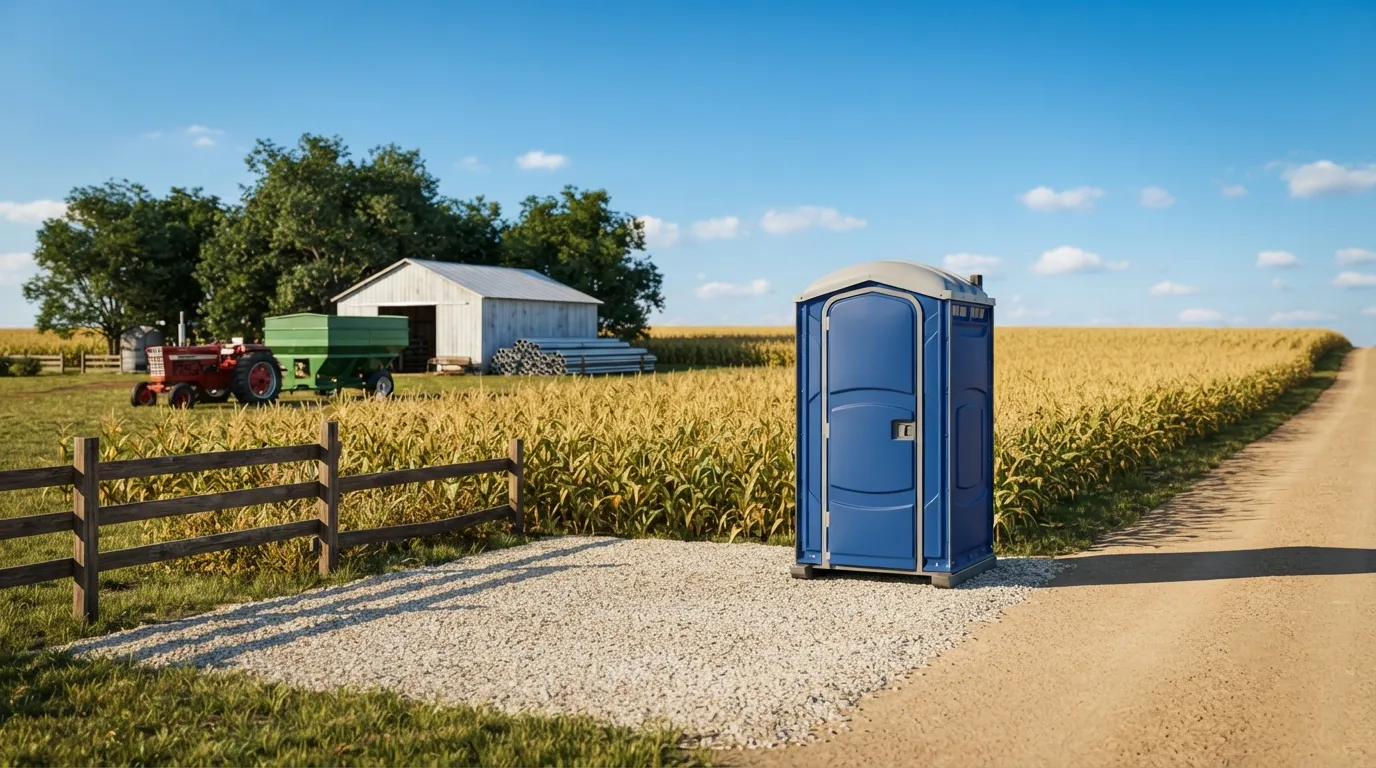
OSHA 1928.110 sets the baseline for agricultural field sanitation: one toilet facility, potable water and a handwashing setup for every 20 hand-labor employees, placed so nobody walks more than a quarter mile to reach it. That is different from the construction ratio in OSHA portable toilet requirements, which allows one unit per 20 workers on a jobsite without the quarter-mile rule. Farms spread over acreage, so one unit at the barn does not cover a crew picking rows a half mile out. Most operations around North Peoria end up placing two or three standard porta potty rentals at different points along the field edge rather than one unit at the entrance. If you are not sure how many stations your acreage needs, our placement guide walks through spacing by field size, and how many porta potties do I need covers crew-size math in more detail. Water matters too: OSHA 1926.51(a)(1) requires an adequate supply of potable water at any place of employment, and that applies to seasonal ag labor as much as it does a construction trailer. A standard unit holds a 60 to 70 gallon tank, which covers a crew of 10 to 15 for close to a week under normal use before it needs servicing.
Where should units go on a working farm?
Placement matters more on a farm than almost any other jobsite, because ground conditions and equipment traffic change by the week. A unit needs firm, level footing, ideally on gravel or packed dirt rather than soft field edge that ruts under a service truck. Keep clearance in mind: a delivery truck needs room to maneuver, and if you are also renting a roll-off dumpster rental for outbuilding cleanup or fencing debris, that truck needs about 60 feet of straight clearance behind it to set the container down. Farms near Washington, 12.1 miles east of North Peoria, and Morton, 15.1 miles southeast, often combine restroom service with a temporary fence rental around grain bins or equipment yards during harvest. If your crew includes anyone with a mobility limitation, ADA Standards section 302.1 calls for stable, firm, slip-resistant ground at accessible units, which usually rules out loose gravel or turf. An ADA accessible porta potty needs a 60 inch turning circle under ADA Standards 304.3.1, so pick a spot with room around it, not just in front of the door.
Do farm restrooms need handwashing stations too?
Yes. OSHA 1928.110 requires handwashing water alongside the toilet, not just inside it, and 29 CFR 1910.141(d)(2) is clear that hand sanitizer alone does not satisfy a washing requirement where soap and towels are called for. If your crew handles pesticides, herbicides or treated seed, OSHA 1926.51(f)(1) requires washing facilities specifically because of that chemical exposure, separate from the general sanitation rule. A handwashing station rental or portable sink rental placed next to the toilet unit covers both requirements at once. Some operations ask about a hand sanitizer station rental as a supplement between full washes, which is fine as an add-on but does not replace soap and water where the standard requires it. For full detail on what counts and what doesn't, see handwashing station requirements.
| unit | duration | typical price |
|---|---|---|
| standard | day | $150 |
| standard | week | $200 |
| standard | month | $200 |
| delivery_fee | week | $100 |
Multi-week harvest jobs usually make more sense on the weekly or monthly rate than paying by the day each time; see monthly porta potty rental or porta potty rental cost for the full breakdown, and porta potty rental per day if your labor need is short and unpredictable. Farms running septic systems for a farmhouse or bunkhouse should also plan ahead: a residential tank is typically pumped every 3 to 5 years depending on size and household count, and septic pumping service or how often to pump a septic tank covers scheduling. If a line backs up mid-harvest, emergency septic service and emergency porta potty rental both run on short notice.
How far in advance should I book for harvest season?
Book as soon as you know your labor start date. Harvest crews across North Peoria and out toward Pekin, 19.8 miles south, tend to book restrooms and temporary fencing at the same time equipment gets scheduled, and units get tight in peak weeks.
Can I put a unit at the edge of a field instead of near the barn?
Yes, and often you should. OSHA 1928.110's quarter-mile rule means field-edge placement is usually required, not optional, once your crew works acreage that far from a central building.
What if my farm doesn't have hand-labor employees, just family?
The 1928.110 ratio applies to hand-labor employees specifically. Family operations without hired labor aren't bound by the same count, though a portable restroom rental still makes sense for guest workers or seasonal help.
Do I need a permit to place a unit on my own farm?
Placement rules vary by property and jurisdiction, and this has not been verified with the city for agricultural land specifically. Check current requirements before delivery; see porta potty permit requirements for general guidance.
Can the same company handle restrooms and a dumpster for outbuilding cleanup?
Yes. North Peoria Porta Pros delivers portable toilets, roll-off dumpster rental, and temporary fence rental together, which simplifies scheduling one delivery window instead of three.
Next step
Get a delivery date
Tell us the address, the dates and the headcount. We size the order and confirm the route.