
Last updated
How many restrooms does a marathon need?
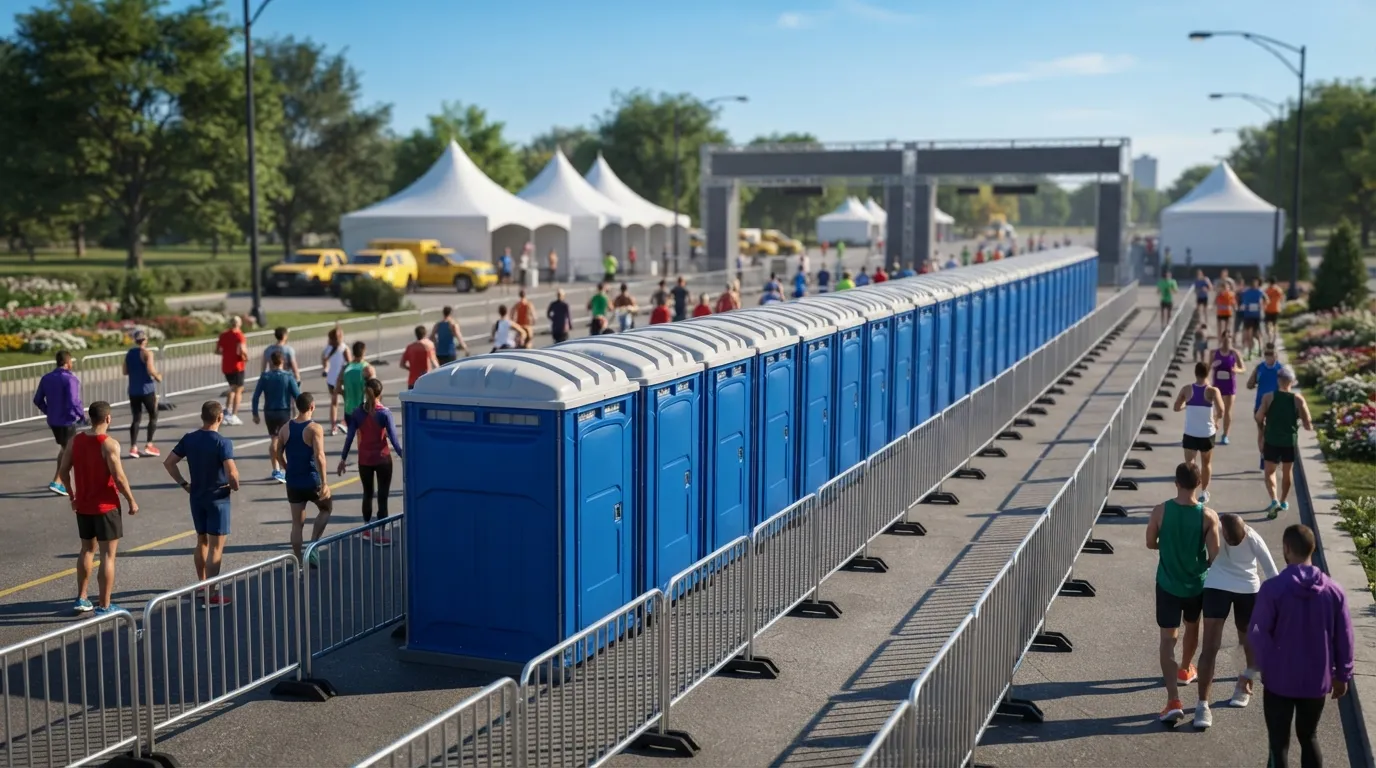
Runner count drives the number, but course layout drives placement. A standard unit holds a 60 to 70 gallon tank and sits about 44 by 48 inches on the ground, so clusters of eight to ten fit into a start-corral footprint without crowding the timing mats. For a race pulling from North Peoria and towns like Peoria Heights, 3.1 miles east, or Washington, 12.1 miles east, expect runners and spectators both, and spectators need their own bank near parking, separate from the athlete corral. Check how many porta potties do I need for a fuller breakdown by headcount. Race organizers running a point-to-point course should also plan restrooms at the finish line days ahead, since event restroom rental crews need lead time to route trucks along the closed course. If your race qualifies as a competitive event with paid staff on course, OSHA 1926.51(c) sets a baseline of one toilet per 20 workers, which applies to your medical tent crew and volunteer marshals even though it was written for construction sites. For runners with mobility needs, ADA Standards section 213.2 requires at least 5 percent of a cluster be accessible units, never fewer than one, so a bank of twelve needs at least one ADA accessible porta potty at every major stop, not just the start.
What restroom setup works best for aid stations?
Aid stations along the course need lighter footprints than the start and finish. One or two standard porta potty rental units per aid station usually covers a rolling field of runners, since nobody lingers mid-race. Where your course crosses back through North Peoria near a second aid point, doubling up saves a truck trip. If the race includes a health fair or spectator zone at the finish, a deluxe flushable porta potty bank reads better in photos and holds up under heavier weekend traffic. Races that also serve food at the finish, chili feeds, pancake breakfasts, that kind of thing, should pair restrooms with a handwashing station rental, since 29 CFR 1910.141(d)(2) requires soap and towels or a hand-drying device at wash stations, not sanitizer alone. If your course crew is out overnight setting up lighting near the finish line, a light tower rental paired with a temporary power pole keeps the area lit and safe. Knowing how to brace a temporary power pole matters more than people expect, since a top-heavy fixture in open ground near a finish chute can shift in wind if the base isn't anchored and guyed before race morning; crews should stake or ballast the base and check the guy lines again after tents and signage go up, since added surface area catches more wind.
Where should race organizers place units along the course?
Placement rules follow the same logic as any large event: stable ground, clear access for the pump truck, and a route wide enough for a wheelchair user to reach the door. ADA Standards section 403.5.1 sets a 36 inch minimum clear width on the path to an accessible unit, and section 404.2.3 requires a 32 inch clear door opening once they're there, so don't tuck the accessible unit behind a table or generator. Section 304.3.1 also calls for a 60 inch turning circle in front of the unit, which matters on grass where footing can shift. See the full porta potty placement guide before you finalize your course map. If your race falls on city streets, confirm placement in the public right of way with North Peoria before race weekend; that's not something to guess at, and the porta potty permit requirements page walks through what to ask. Races drawing from farther out, Morton sits 15.1 miles southeast and Pekin 19.8 miles south, may want a satellite bank near remote parking so shuttle riders aren't walking a quarter mile to the nearest unit. For multi-day festival-style races with vendor villages, look at festival restroom rental and concert restroom rental for setups built around dense foot traffic rather than a moving field.
| unit | duration | low | typical | high |
|---|---|---|---|---|
| standard | event | 200 | 400 | 800 |
| ada | weekend | 199 | 240 | 300 |
| deluxe | week | 150 | 250 | 290 |
Pricing runs by event length and unit type; see porta potty rental cost for how race-day rates compare to a standard weekday rental.
How far in advance should we book race restrooms?
Book as soon as your course map and runner count are set, ideally weeks out for a race pulling from North Peoria and neighboring towns. Race weekends compete with weddings and festivals for the same trucks. Late requests still get handled through emergency porta potty rental when plans change fast.
Do we need separate units for runners and spectators?
Yes. Runners need units at the start, finish, and aid stations; spectators cluster near parking and the finish line viewing area. Mixing the two creates lines right when runners need speed most. Plan two separate zones per how many porta potties do I need.
Can we get restrooms delivered along a closed course?
Yes, but tell your delivery contact the road closure schedule early. Trucks need a clear path, and a closed course can block the usual route. Coordinate delivery windows before closures start, not the morning of.
What if our race includes a health and wellness expo?
Add a separate restroom bank near the expo tents, since foot traffic there runs all day, not just race hours. A deluxe flushable porta potty cluster handles that steadier demand better than standard units alone.
Are hand-washing stations required at aid stations?
Not strictly required at every aid station, but strongly recommended anywhere food or gels are handed out. Pair a portable sink rental with your food tables to keep runners and volunteers covered under basic sanitation practice.
Next step
Get a delivery date
Tell us the address, the dates and the headcount. We size the order and confirm the route.